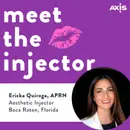
Ericka Quiroga, APRN - Aesthetic Injector in Boca Raton, Florida


 RSS Feed
Her first Botox came from a Groupon, and the injector pointed out a flaw in her chin she had never noticed. Years later she still thinks about it, and she promised herself never to point out anything a person hasn’t asked about.
Ericka is a nurse practitioner and aesthetic injector at Handal Plastic Surgery in East Boca Raton, Florida, where she works alongside plastic surgeons Dr. Arthur Handal and Dr. Michael Plastini. Before aesthetics she spent more than 10 years as an emergency room nurse in South Florida, taught undergraduate nursing, and published research on teaching new nurses to recognize the signs of human trafficking.
Her plans start with skincare, because you can fill a wrinkled silk shirt all you want and the wrinkles stay. She says no to overfilling several times a week, explains why someone asking for 15 syringes of filler sometimes needs a facelift instead, and describes the vascular occlusions she saw in the ER when nobody had enough hyaluronidase. She also talks about hormone replacement therapy, GLP-1s, and why she only uses peptides from a licensed pharmacy.
Learn more about Ericka at Handal Plastic Surgery
Follow Ericka on Instagram and TikTok @thebocainjector
About Meet the Injector
Whether you’re trying injectables for the first time or making a change to a new provider, the more you can learn about who your aesthetic injector is before you’re in the chair, the better that appointment will be.
When choosing an injector, you want someone who knows their way around neuromodulators like Botox, Dysport, and Daxxify, fillers like Juvéderm and Restylane, and biostimulators like Sculptra.
Meet The Injector features trusted professionals sharing their expertise and stories, so you can feel confident about who you trust with your face. There’s no substitute for an in-person appointment, but we hope this comes close.
Meet The Injector is a production of The Axis.
Made with love in Austin, Texas.
Are you an aesthetic injector or do you know one? Book your free 30 minute recording session here.
Host: Eva Sheie
Assistant Producer: Mary Ellen Clarkson
Engineering: Victoria Cheng
Theme music: Ganga by Ooyy
Eva Sheie (00:03):
Whether you're trying injectables for the first time or making a change to a new provider, the more you can learn about who your injector is before you're in the chair, the better that appointment will be. You're listening to Meet the Injector. Good afternoon. Welcome to Meet the Injector. My guest today is Ericka Quiroga and she is an aesthetic injector in Boca Raton, Florida. Welcome to the podcast.
Ericka Quiroga (00:27):
Thank you. Thank you for having me.
Eva Sheie (00:29):
It took us a while to actually get here. We kept rescheduling, so I'm glad we finally made it.
Ericka Quiroga (00:33):
Finally, yes.
Eva Sheie (00:36):
Tell me a little bit about how you got into injecting.
Ericka Quiroga (00:39):
So doing prerequisites before nursing school, long story short, I worked in a dermatology office and that's kind of in the early 2000s. That's when Botox started to come around and more of aesthetic medicine with the fillers. And I always was fascinated about how a little tweak can really change someone's confidence. And I suffered from acne, adult acne as well. So I always kind of had it in the back of my mind. And then being burnt out in the ER for over 10 years as a nurse, I kind of decided once I became a nurse practitioner that I really wanted to see if I had a niche in aesthetic medicine and ended up I did.
Eva Sheie (01:16):
That door sounds like my cat. She might make an appearance too. She's been known to do that. So do you remember the first time you ever got Botox yourself?
Ericka Quiroga (01:28):
Yes. I did a Groupon, which I -
Eva Sheie (01:32):
Don't recommend.
Ericka Quiroga (01:33):
No, don't recommend. And the injector made a comment about my chin and it made me really insecure about my chin for years. So it was a great experience for the injectable wise, but I made a promise to myself never to point things out to patients unless it was something bothersome to them. And I had no idea that I had an issue with my chin. So that was a negative.
Eva Sheie (01:57):
I can relate to this.
Ericka Quiroga (01:58):
Yeah.
Eva Sheie (01:59):
I had a boyfriend once who said something about my nose and that was 30 years ago and I never forgot.
Ericka Quiroga (02:04):
It sticks with you.
Eva Sheie (02:04):
Yeah. Yeah, it does.
Ericka Quiroga (02:06):
So I never want to do that to someone. We all have our insecurities and it was a new insecurity that she found and I just still probably obviously haven't gotten over it. But I do love Botox. I'm very expressive, so sometimes I need it. It helps. And I love how you can kind of change, do little subtle enhancements with just an easy injection.
Eva Sheie (02:30):
Is there a question that you ask when you're seeing someone for the first time so that you kind of get to know what it is that they're thinking?
Ericka Quiroga (02:38):
Yeah. Usually a lot of my patients will tell you, especially when I first meet you, it's kind of more of a conversation that I have with them. I'll ask them, I'll hand them a mirror. What are some things that you're looking at right now that bother you? Or if someone were to take a candid photo, what's something that jumps out at you that you don't like when you look at that? And then kind of just spin off from there. What are some realistic expectations or plan of care? It's not something I want to do all in one session. It's over the span of six months to a year. And sometimes they're surgery candidates.
Eva Sheie (03:10):
Does anyone ever make you laugh or say something that you're not expecting?
Ericka Quiroga (03:15):
All the time. And my patients would probably say the same if I'm doing educational and I'll say sphincter muscles kind of like back there to give them more visualizations. And there's some patients that are like, I'll never stop thinking about my eyes being a sphincter muscle.
Eva Sheie (03:32):
That's memorable.
Ericka Quiroga (03:33):
Yeah. But yeah, my patients, I'm very lucky. I have a great patient base and we laugh and have a great time most of the time or a little tissue, little crying sessions, but you're in them all stages of their life.
Eva Sheie (03:48):
So your patients kind of become your friends?
Ericka Quiroga (03:51):
Yeah. Yeah. A lot of them are.
Eva Sheie (03:54):
Do you ever see them around town when you're out doing stuff?
Ericka Quiroga (03:57):
Yes. And I will not come up to them. I'll wait for them to come up to me just because I don't know how they want to introduce me or if they want to introduce me. Some people like to still kind of keep that part of a private that they don't get injections or filler or lasers or anything like that. So I try to respect their privacy.
Eva Sheie (04:16):
What's the practice like where you work? Tell me more about that.
Ericka Quiroga (04:20):
So it's a busy plastic surgery practice in East Boca. We're building a med spa upstairs, hopefully at the beginning of next year. We have two plastic surgeons here, Dr. Handal and Dr. Plastini. So we do everything face, body contouring, all of that, which helps too for patients because sometimes injectables or lasers are needed. So they'll introduce myself to the patient or sometimes I can't help them with my little box of magic tricks that I have and it's more of a surgical intervention.
Eva Sheie (04:50):
How did you find the practice? How did they come to hire you there?
Ericka Quiroga (04:54):
So unfortunately their nurse practitioner that they had at the time moved to Texas and it was just, I would say the universe just saying it was meant to be. I had four different relationships that didn't commingle and they all were like, "Oh, we have this injector. Oh, we know this plastic surgeon that's looking for a nurse practitioner, an injector. We think you'd be a great fit." And it just kind of happened organically.
Eva Sheie (05:18):
That is the best way to get a job, isn't it?
Ericka Quiroga (05:20):
Yeah. I wasn't looking. It just kind of happened and it was just at the perfect time.
Eva Sheie (05:25):
Yeah. Where were you when that happened? Where were you working before?
Ericka Quiroga (05:28):
I was working at a med spa in Boynton and West Boca. So I do like the plastic surgery aspect of it, the more medicinal side too, that sometimes med spas don't offer.
Eva Sheie (05:41):
Yeah. You probably have a lot more tools in the toolbox now that you're working with surgeons.
Ericka Quiroga (05:47):
Yeah. And I can help the patients more. I think that's really the whole basis of it is that it's what's best for the patient and me upselling them 50 syringes of filler is going to overfill them and not lift or support or change something that they may need. You see on Instagram that they're doing 15 syringes of filler and sometimes it's just a facelift.
Eva Sheie (06:11):
15 would be a lot. Have you actually seen 15? I mean, you're in Florida, so I think you probably see some extremes around you.
Ericka Quiroga (06:17):
Yes. Personally, I have not injected 15. I think the most I've injected on a patient was six. We were doing full facial balancing. I don't like to do a lot at once because I think it can kind of interfere sometimes with people's psyche. But yes, unfortunately in South Florida, we do see a lot of overfilled patients.
Eva Sheie (06:39):
Somebody once showed me what a syringe looks like when it's in a teaspoon and it really isn't that much.
Ericka Quiroga (06:47):
No, it's very small.
Eva Sheie (06:48):
It's tricky. And then the way that they're measured in units, the units are different. And I didn't realize until later that a unit was an imaginary measurement.
Ericka Quiroga (06:58):
Yes.
Eva Sheie (07:00):
And so the unit is whatever the company says it is, which is why we all end up in the, how come this much Dysport isn't the same as this much Botox?
Ericka Quiroga (07:08):
And the reconstituted difference.
Eva Sheie (07:09):
It's on purpose to confuse you. Yeah.
Ericka Quiroga (07:14):
Yeah.
Eva Sheie (07:15):
Tell me more about how you come up with the plan for a long-term rejuvenation for somebody, especially if they're coming to you for the first time.
Ericka Quiroga (07:24):
I definitely think skincare is first. I always kind of do that analogy that you can have a wrinkled silk shirt, you can overfill it as much as you want to, but the wrinkles are still going to be there. So we need to kind of iron that out. So I really think first starting with your canvas of skincare, getting the skin looking healthy, whether that's with microneedling or a type of laser, then we can kind of go into more of the injectables or collagen, the biosimulators if needed. Also, it depends on the patient's budget and downtime as well, but medical grade skincare is something you do every day, twice a day, and you'll get the best bang for your buck long term for that. And then just do little pearls and little tweaks here and there. I'm more of an injector that wants my patients to have that natural refreshed rejuvenated.
(08:14):
I don't want to do that wow factor because sometimes in person, the wow factor is a little scary and they look like Maleficent or jigsaw, but they may look great in pictures.
Eva Sheie (08:24):
It'd be more like the wow factor instead of the...
Ericka Quiroga (08:27):
Yeah, like wow, where'd you go? And I don't also want that reputation either.
Eva Sheie (08:33):
Not that wow factor.
Ericka Quiroga (08:34):
No, no, no. So sometimes some patients that want that look, I try to counsel them as much as possible and give them realistic expectations or tell them no.
Eva Sheie (08:47):
Oh yeah. How often do you have to say no?
Ericka Quiroga (08:49):
A lot. I'd say multiple times a week. Being in South Florida, the only downfall is you can throw a ball and it'll hit a med spa. We're so close to each other and there's some people that are for profit and not for patients. So they'll say yes and do the overfilling.
Eva Sheie (09:07):
This has been a really big topic over the last couple of years when the overfilling started. How do you think the overfilling started and how do you think that we're correcting it back in the right direction now? I feel like that's sort of what's happened nationwide and I wonder what you've seen.
Ericka Quiroga (09:27):
Yeah. I think the body dysmorphia, I mean, personally even as an injector, when I was beginning injecting, there'd be weeks where I'd do a lot of cheeks and then I started to think I needed more or I needed cheeks like that too because I would just see these great cheeks now being built. I'm like, "Oh, I need that. I don't have that." Or lips. So you think you need a little bit more and it just goes down this rabbit hole where it's like, "That looks great on that patient. Maybe I should do that." I also think people don't say no or really educate like, "No, this is a surgery or this is an energy based kind of type of treatment." But I think now a lot of people are becoming more educated, which is great. Social media, it's a good thing, bad thing, which is having them ask more questions and we're advancing more for more bio-regenerative and natural results, which I think is good.
(10:16):
We didn't have that much, like the peptides and things like that, I think a few years ago.
Eva Sheie (10:21):
Yeah. It really has changed a lot. It always shocks me that it'll seem like everything has stayed the same forever and then one day it just feels like it all changes at the same time. Here we are. We're all doing the same thing. There's nothing new and then it turns upside down.
Ericka Quiroga (10:40):
Always. And there's not a lot of education. Aesthetics is still kind of like the wild west, I feel like. So it's really important to go to as many trainings. I'll never say no to a training, even if it's something I've done a thousand times before. And I'm very lucky that I get to see surgery with facelifts and everything. So I'm always looking at anatomy. A cadaver lab was a little bit different than an actual live human. So I'm very grateful that I'm able to have that knowledge. Yeah. Ideally, right? But I'm very grateful that I get to constantly have that too in my back pocket.
Eva Sheie (11:15):
Have you started helping patients also with weight loss and hormones and things like that?
Ericka Quiroga (11:20):
Yeah. I brought on hormone replacement therapy here. I have been dealing with weight loss, the GLP-1 since 2021. When they first came out, I started learning and prescribing for patients. We also do a little bit of peptide therapy here as well.
Eva Sheie (11:36):
What does that look like? That's very new.
Ericka Quiroga (11:39):
It's very new. I do blood work. I do very comprehensive history and physical with the patients. Some patients are not candidates. We try to educate as much as we can. I personally have tried a couple of peptides so I can speak on the ones that work. And also we want to stay with the ones that are legal and not for research purposes only or things like that. So we only use one pharmacy that is licensed and insured and they don't use the research only. It's not like in a gray market or black market area. So that's important too.
Eva Sheie (12:09):
Yeah. I think even just describing that segment of the market is still really confusing for a lot of people. It is important where you get it and that someone's there to help you.
Ericka Quiroga (12:23):
Yeah. And I think big pharma, like what they're trying to do with retatrutide, they're trying to make it a biologic for more for profit and no one's going to give a $5 million if not more to the FDA to test these peptides, especially since there's so many. I do think they're great, but it is a little bit of a concern and you have to be cautious because we don't know longevity wise how it's going to affect or if it's going to feed cancer cells that weren't there, things like that. So it's very... Yeah.
Eva Sheie (12:54):
It's going to get interesting.
Ericka Quiroga (12:56):
Unfortunately, yeah.
Eva Sheie (12:59):
Okay. So one of the things I learned about you in my research was that you have a heart for teaching and also for helping victims of human trafficking.
Ericka Quiroga (13:16):
You did do you research.
Eva Sheie (13:16):
I try. Well, how does education play a role in your career today? And then we'll come back around.
Ericka Quiroga (13:24):
I think it's medicine like what we were talking about. It's always evolving and I want patients to understand why I'm recommending something or why I'm injecting the way I'm injecting or lasering the way I'm lasering. I think knowledge is power and I think everyone should have that. I want my patients to understand and feel comfortable and make sure that they feel heard and that their questions are answered. That stems back from personal experiences, being a patient or loved ones that were patients and just seeing the difference that the physicians or the providers or the nurses would give by actually educating, explaining and counseling. And that really became a passion for me. And I did undergrad nursing. I was a professor for undergrad school as well. So really trying to give them my experiences, my knowledge and the support that sometimes isn't always there.
Eva Sheie (14:17):
Yeah. It's really important. And then the human trafficking thing, how did that happen?
Ericka Quiroga (14:22):
So I was an ER nurse for a while. I had some patients -
Eva Sheie (14:27):
In Miami?
Ericka Quiroga (14:29):
South Florida, so like Boynton area and Broward County. And I've had some patients that were human traffic victims. I did come up during my graduate, we had to do a capstone. So I really wanted to do a experiment with a urine cup for a sticker, the same as a cap, because we always need a urinalysis for those of childbearing age. And it took too long, so I wasn't able to do it, but I did a shorter one for educating new nurses on human trafficking and see if it helped or not. So that's where I was published in a journal article for it for school with a couple other students. But it's sad. It's very prevalent down here or even in Florida in general. And I don't think there's a lot of resources that there needs to be a lot of education and I don't think a lot of people pick up on the signs.
Eva Sheie (15:25):
Are you saying that the cap was going to be a secret signal in some way for those victims to tell you that something was wrong?
Ericka Quiroga (15:33):
Yeah. I wanted it to have in different languages in the bathroom, have them go in by themselves, keep them. I think at least in the initial, they shouldn't have visitors and it could help for domestic abuse as well. If they felt like they were unsafe or needed help, they would just put the sticker underneath the urine cup. So either a nurse or a medic would get the urinalysis if they'd see the sticker, then we'd know to clear everyone out and just leave the patient and kind of find out what's going on.
Eva Sheie (16:00):
Yeah. I'm trying to remember where it is that I go that there's like a tell the bartender you want an angel drink. It's at the big concert venue here in Austin at the Moody Center. In the bathroom it says, "Order an angel shot and the bartender will know what it means." It's like the same kind of idea.
Ericka Quiroga (16:20):
Yeah. And I wish I had the time to do it or just took it upon myself to collect my own data. I'm not in the ER anymore, but that's still something that I think would be great if I could help someone start that to see if it would really help or kind of spearhead that study because I think it's needed. Even with domestic, it doesn't need to be human trafficking. I just think there's more victims out there than we realize.
Eva Sheie (16:44):
There are. My mom has spent the last 12 years working on a campaign just to get so small and it's turned so big, but it took forever to get every city organization where she lives to use purple light bulbs outside their buildings in the month of October. And so the first year there was like one police station that would do it. And this year, 12 years later, every city building and tons of businesses all changed their light bulbs to purple for domestic violence awareness. And she was just telling me how long it took to get it to this point, but just to see how much, what an impact they've had now 12 years later.
Ericka Quiroga (17:30):
That's amazing.
Eva Sheie (17:31):
My mom is pretty cool.
Ericka Quiroga (17:33):
She sounds like it. That's awesome.
Eva Sheie (17:34):
Super hard worker. Yeah. In the beginning, she was so scared just to even ask them. And so I did a lot of like, "Well, what's the worst thing that happens if you ask? They just say no." When you were working in the ER, was there anything that you learned that you felt like really helped you move into aesthetics? How did you translate one to the other?
Ericka Quiroga (17:59):
I think obviously people are going to be nervous and it's hard for trusting, especially now in healthcare. I think being in the ER, just trying to calm the patient's nerves and having them feel heard and understood before we do something I think has really helped me in aesthetics, understanding what's making them nervous, what are their concerns, talking to them about it and explaining what to expect, what not to expect, all of that I think has really helped. And I picked that up from the ER, thankfully.
Eva Sheie (18:29):
This might be a funny pivot, but yesterday I was reading in a huge Facebook group of med spa owners, somebody said, "Does hyaluronidase really work?" And 200 people were in there saying, "If you are asking that question, you have no business injecting."
Ericka Quiroga (18:49):
I agree.
Eva Sheie (18:50):
The question I want to ask you is, have you ever seen a vascular occlusion? Did you ever see one in the ER? And have you ever seen one since you've been in the plastic practice?
Ericka Quiroga (19:02):
We did have two in the emergency room and I think we did have hyaluronidase. We didn't have enough and ER doctors aren't trained in that. One kind of waited almost 48 hours till they started having the necrosis to the skin and the blistering and stuff. And we were kind of like, "Holy crap, what do we do?" Kind of thing. We did call a plastic surgeon that was on call and came in. They had to bring their own hyaluronidase though. But that's another thing I think aesthetic medicine should help train emergency staff and urgent care staff for those because people are panicking. You don't know where they got injected or by whom or if they're open or available or answering. So I think everyone should be trained in urgent and emergency medicine for VO.
Eva Sheie (19:48):
Yeah. I agree. I know of someone who did have one and she saw it and she acted very quickly and it was because of her training that she knew what to do quickly and saved that person's face.
Ericka Quiroga (20:02):
Yeah. No, thankfully we've had some complications not by anyone here, but patients that have come in from other injectors with VO complications. So we were able to help them and hyperbariatric and all of that, but it's scary. It can be -
Eva Sheie (20:17):
Do you have a team? Are there other injectors working with you or are you the only one there?
Ericka Quiroga (20:21):
Right now I'm the only one. We have a nurse who just became a nurse practitioner, so she's going to be training shortly on injectables as well. We may be bringing a third one in once upstairs opens, but right now it's myself and the two other plastic surgeons that do the injectables.
Eva Sheie (20:38):
And then what lasers are you doing? What do you have on that menu?
Ericka Quiroga (20:43):
We have the Sciton. So yeah, we have Sciton BBL Heroic, the Tribred, Moxi, Contour TRL. We do have a CO2 laser that we primarily do for patients in the OR. It's a pretty aggressive one. And then we have the IPL and Dialase.
Eva Sheie (21:01):
You have very good taste in lasers.
Ericka Quiroga (21:03):
Yes. Yes, we do.
Eva Sheie (21:06):
Have you done any of those yourself on yourself?
Ericka Quiroga (21:09):
On myself? I was tempted to do a BBL on myself and the Moxi, and then I get nervous. So I will do my own Botox on myself, but when it comes to injectables or other things, I kind of try to defer to one of the other surgeons or the other nurse practitioner that's here. But no, I have not yet, but I want to. I'm just waiting for the downtime.
Eva Sheie (21:31):
Oh yeah.
Ericka Quiroga (21:31):
Yeah.
Eva Sheie (21:32):
Well, BBL. Yeah, that one's fine.
Ericka Quiroga (21:34):
Not so much. Yeah.
Eva Sheie (21:36):
Easy. Yeah. I mean, what do you like to do when you're not at work?
Ericka Quiroga (21:40):
I'm a homebody now, so I love cooking. It kind of calms me down and it's how I express my love to my loved ones. I do like to read, hang out with my dogs, luckily have a home gym. So things like that. I'll go to green markets. Sometimes I'll scuba dive, but not as often, but usually I stay at home. I become bored as I age.
Eva Sheie (22:05):
Yeah. Well, and when you work really hard, you have to have time to recharge. You can't just keep running around.
Ericka Quiroga (22:13):
Yeah.
Eva Sheie (22:14):
Where can we follow you online?
Ericka Quiroga (22:16):
So my Instagram is @thebocainjector, as well as TikTok and Facebook is erickaquiroga. You can find me there, or I'm at Handel Plastic Surgery in Boca Raton, Florida.
Eva Sheie (22:30):
I'll make sure all of those are linked in the show notes.
Ericka Quiroga (22:32):
Thank you.
Eva Sheie (22:33):
And I'm so glad that you came to introduce yourself to us today. Thank you so much.
Ericka Quiroga (22:37):
Thank you so much for having me.
Eva Sheie (22:40):
There's no substitute for an in-person appointment, but we hope this comes close. If you're considering an appointment with this provider, be sure you let them know you heard them on the Meet the Injector podcast. Check the show notes for links, including the injector's website and Instagram to learn more. Are you an aesthetic injector or do you know one? You can be a guest on Meet the Injector. Book your free recording session at meettheinjector.com. Meet the Injector is made with love in Austin, Texas and is a production of The Axis, T-H-E-A-X-I-S.io.